Umberto Cevoli - 2026
About the luthier
Umberto Cevoli was born and raised in Rimini in a family of watchmakers, an environment that shaped his sensitivity to precision, manual discipline, and refined craft from an early age. Alongside his scientific and musical education in Rimini, he studied guitar with Aldo Vianello at the Conservatorio Lettimi and soon developed a lasting interest in the making of instruments. His first guitar, built at the age of eighteen in the workshop of Heidi Pulfer and Pio Sbrighi, marked the beginning of a path that led him toward professional training in lutherie.
He later graduated with highest marks from the Civica Scuola di Liuteria di Milano, where he combined workshop practice with organological study. His final thesis examined proportional systems and units of measurement in the guitars attributed to Antonio Stradivari and explored their possible reconstruction from historical documentation preserved in Cremona. During these years he carried out technical studies on a range of historical instruments and deepened his understanding of historical construction methods. Further experience in the workshop of Enrico Bottelli and continued collaboration with Gabriele Lodi strengthened both his making and restoration practice, especially in relation to historical guitars and the early development of the classical instrument.
Today Cevoli works in Rimini, where his workshop reflects a clear commitment to traditional guitar making informed by direct study of historical models. His work is closely connected to research into proportional design, Spanish traditions of construction, and the material logic of older instruments. Although still early in his career, his formation already shows an unusual breadth, linking practical craftsmanship with sustained historical enquiry.
About the guitar
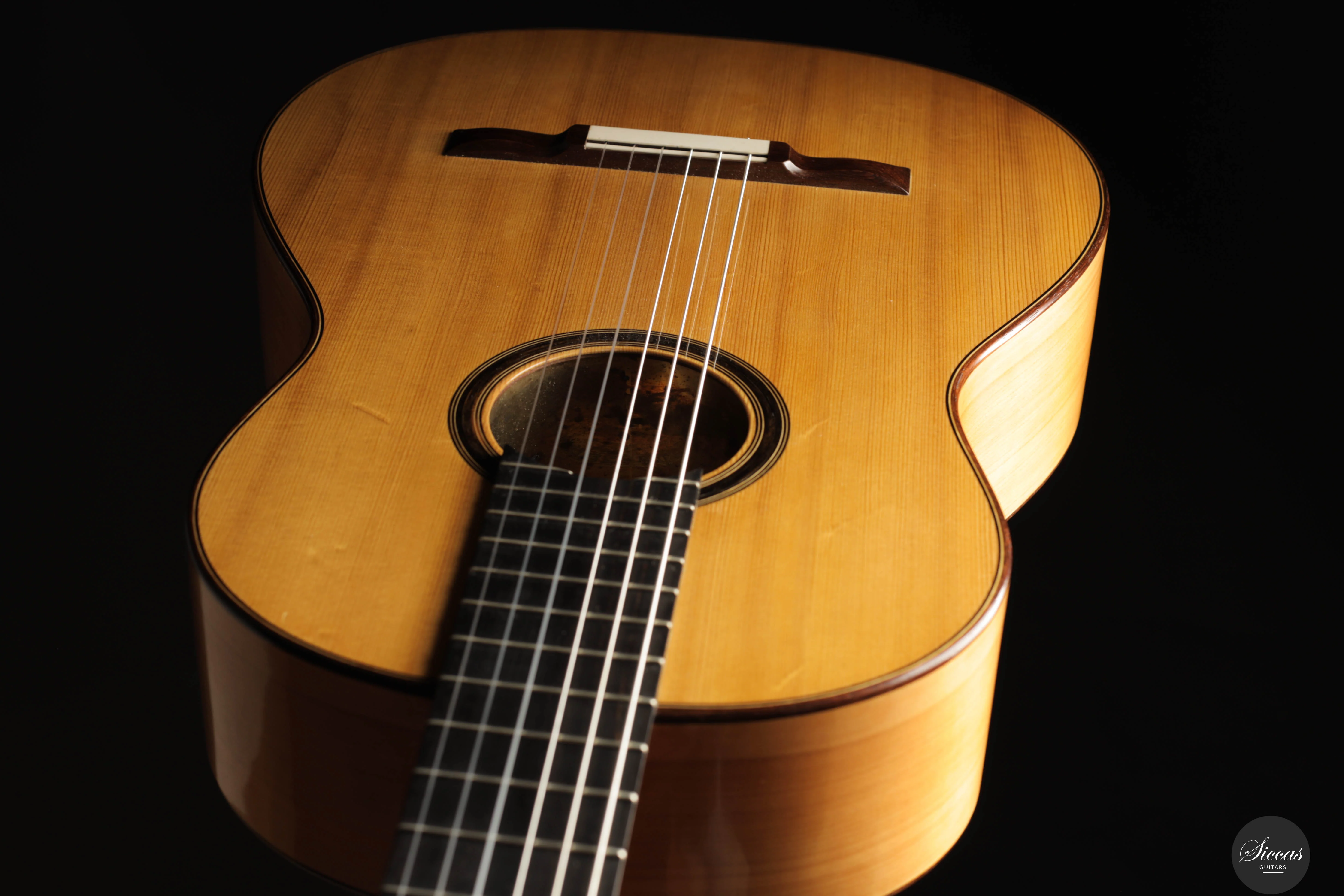
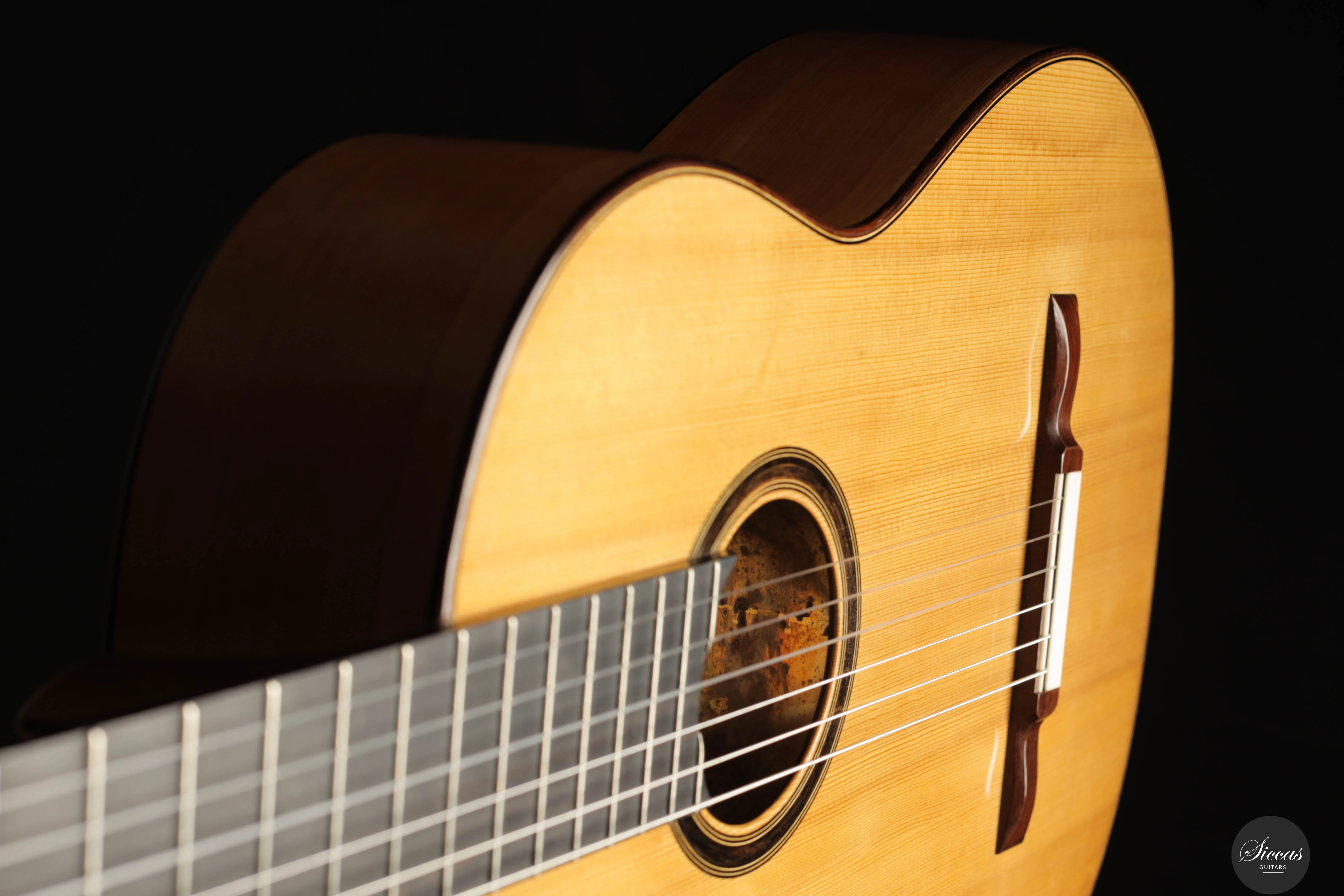
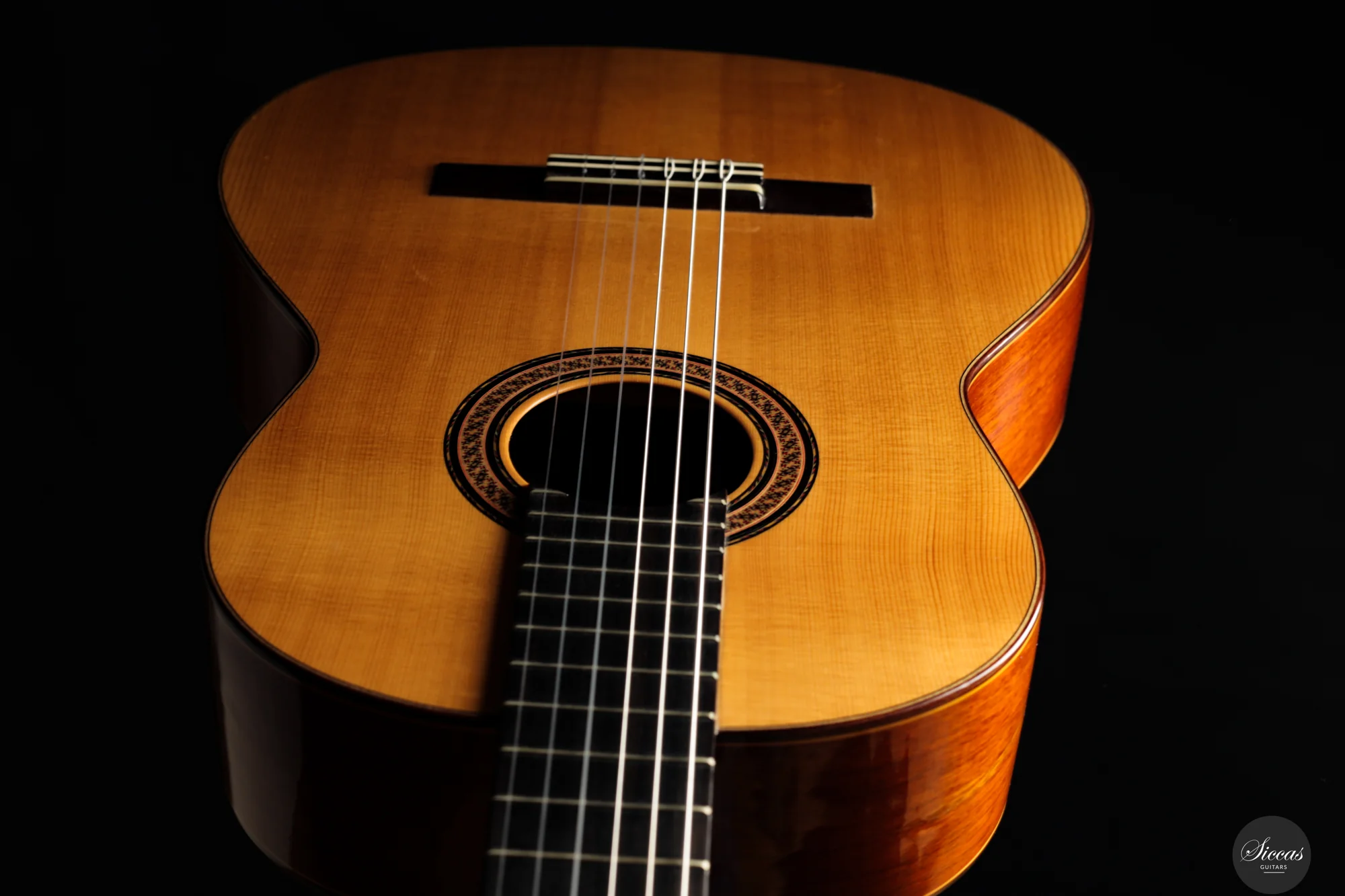
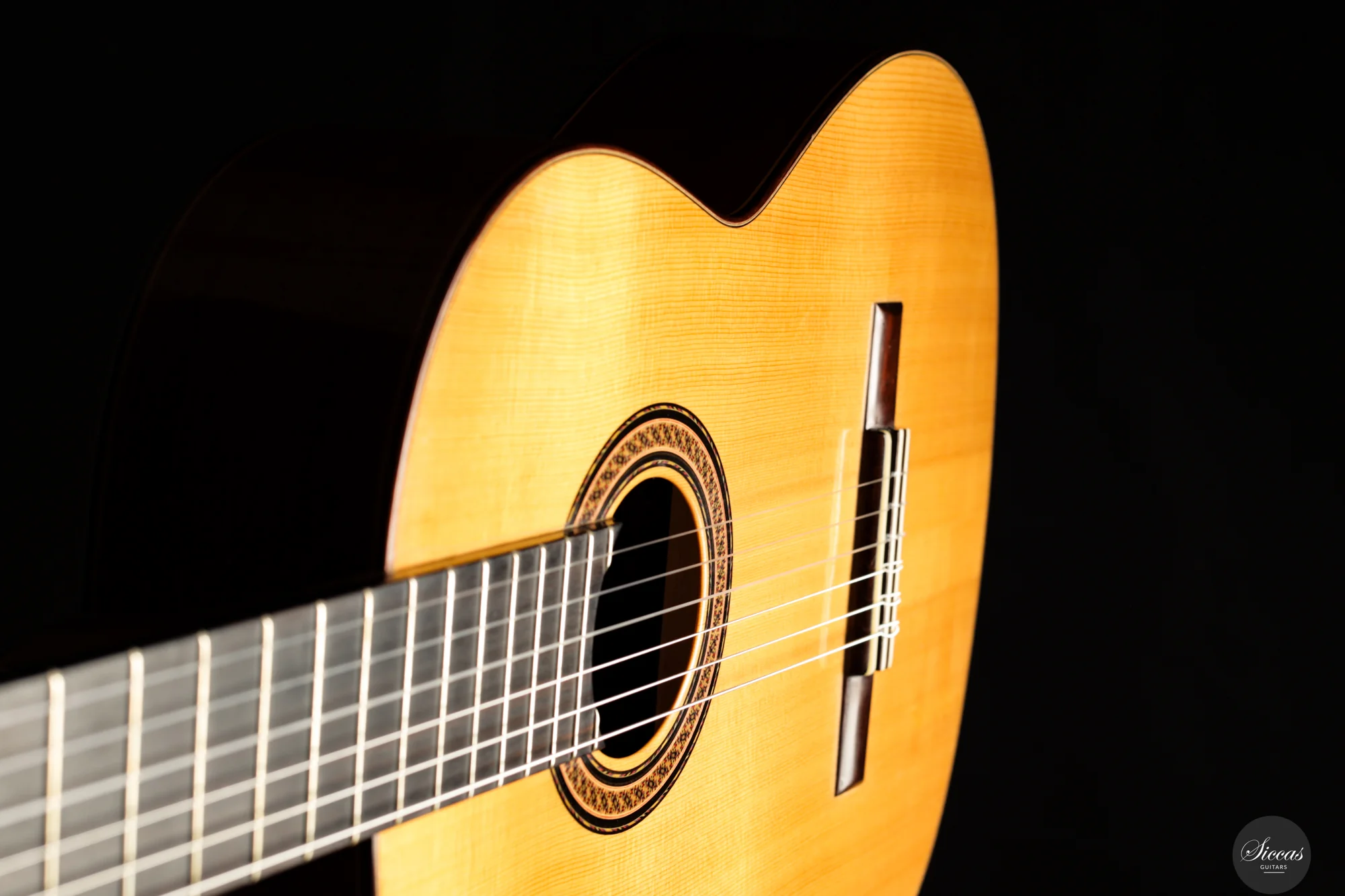
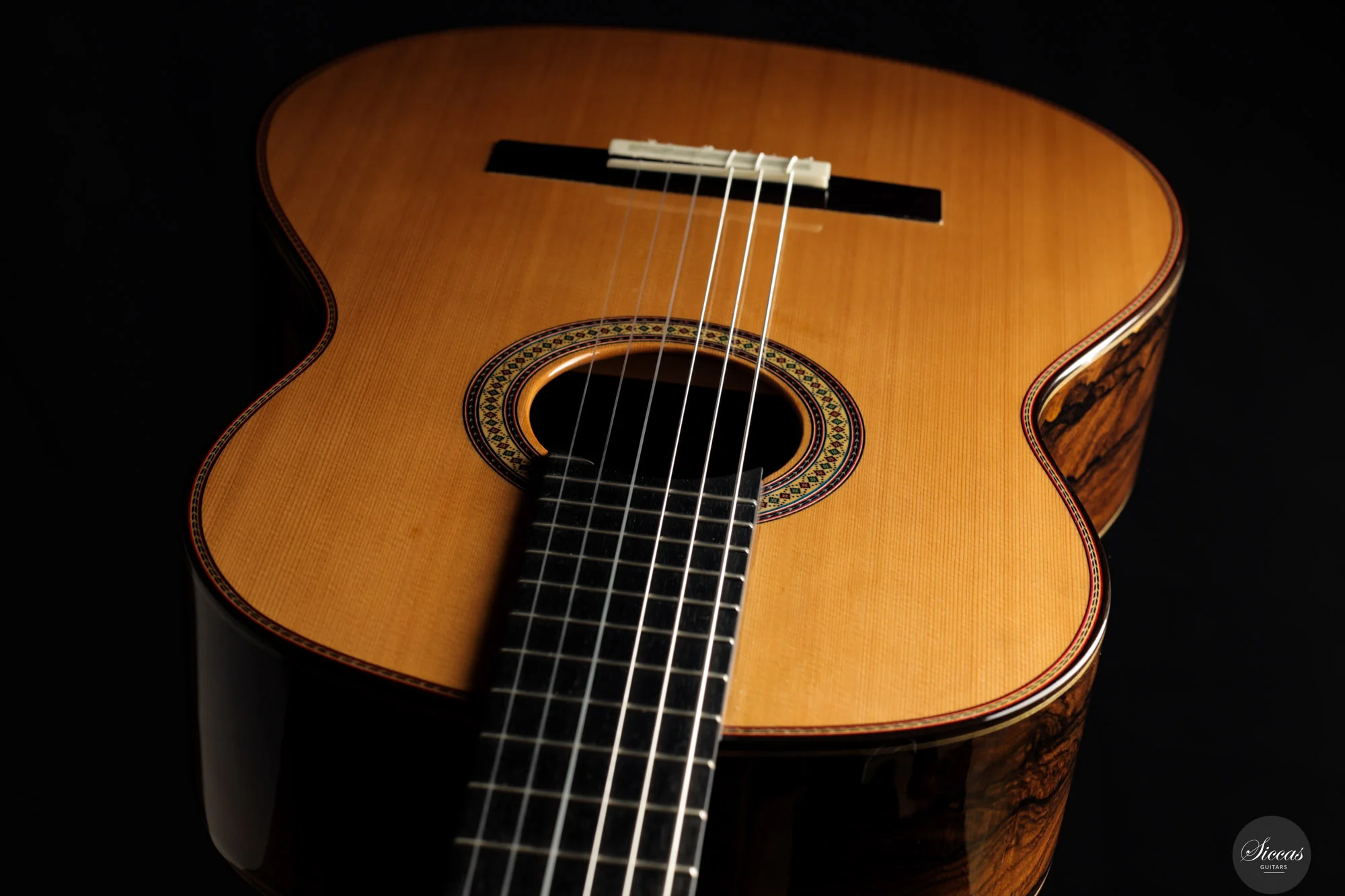
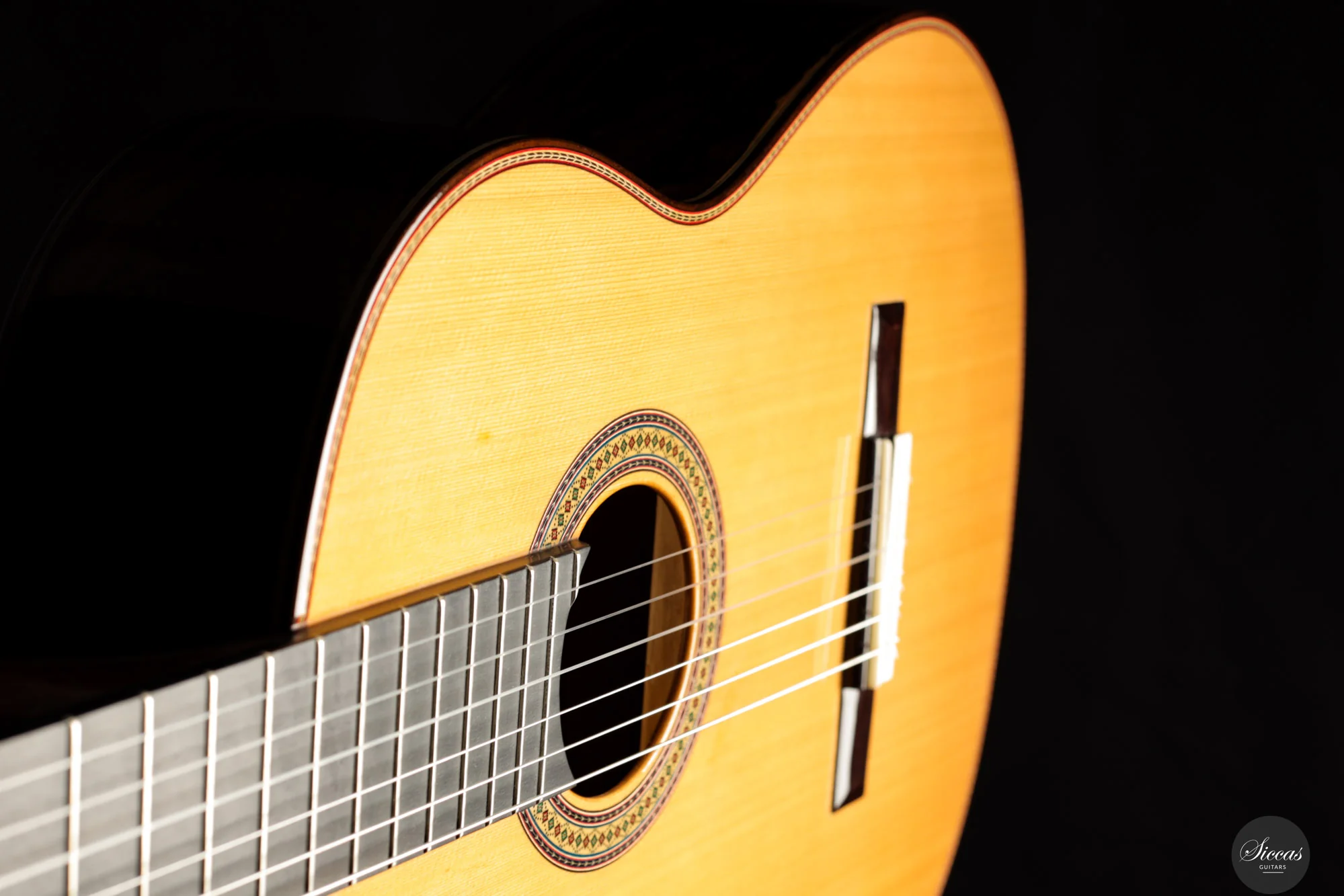
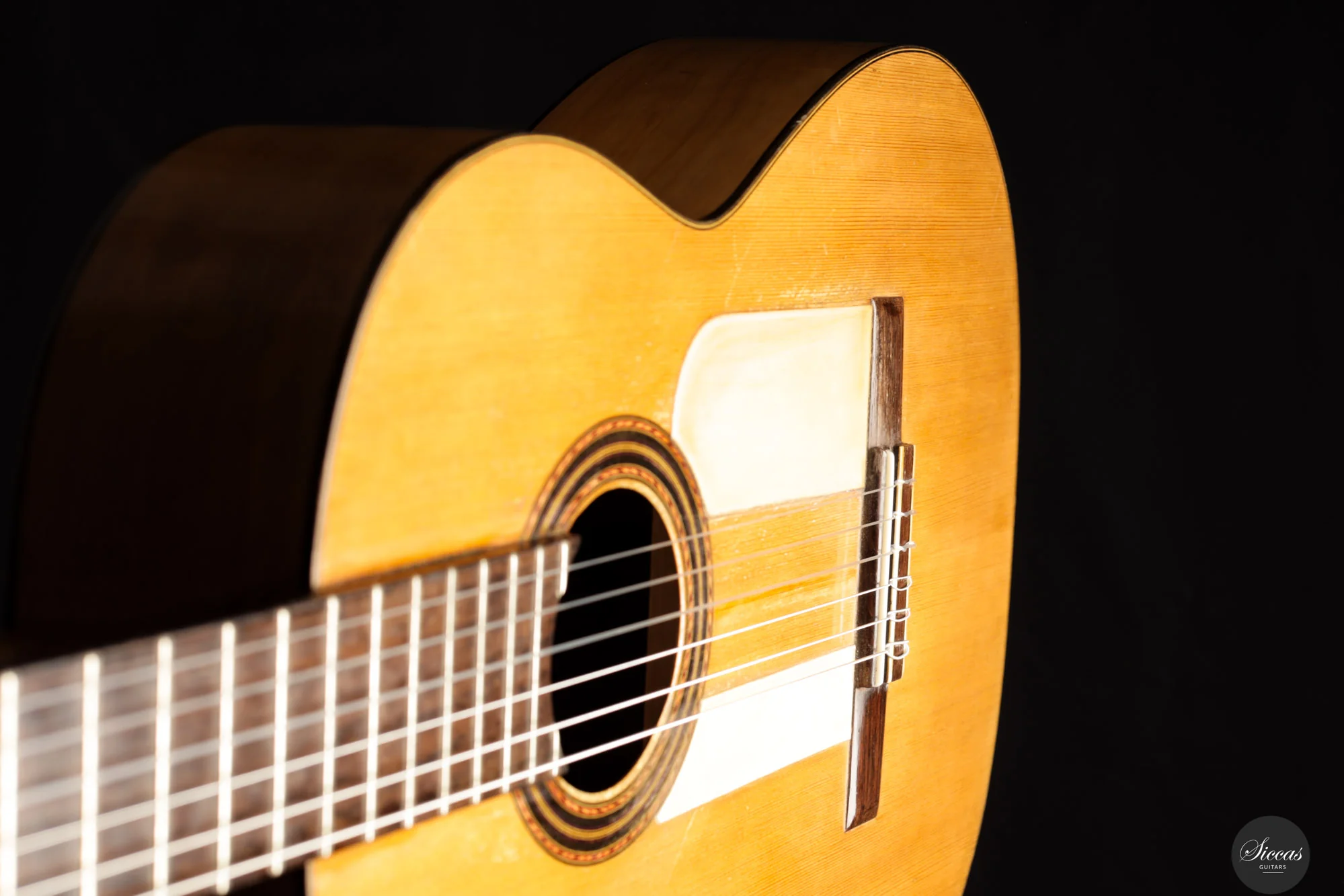
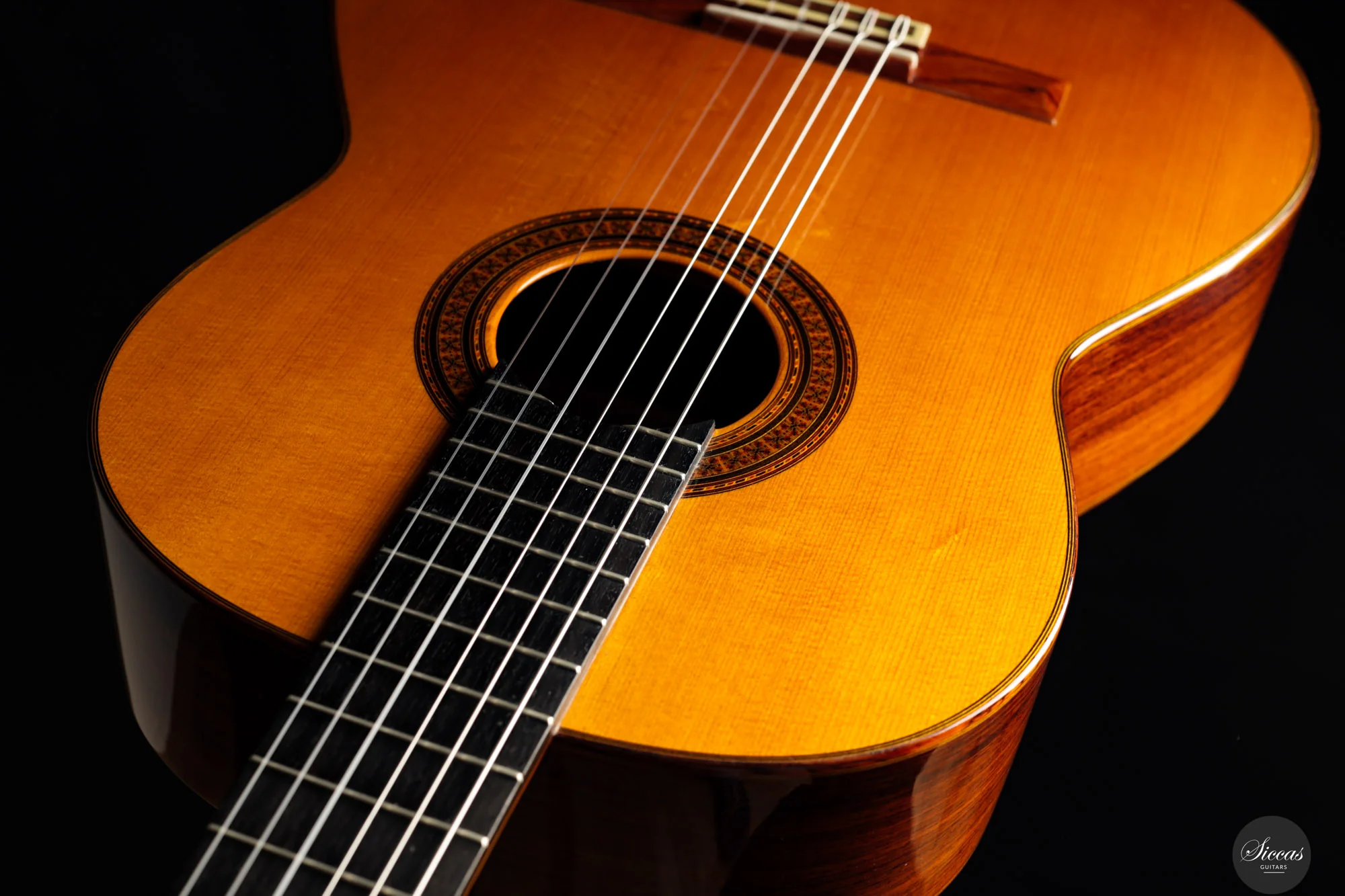
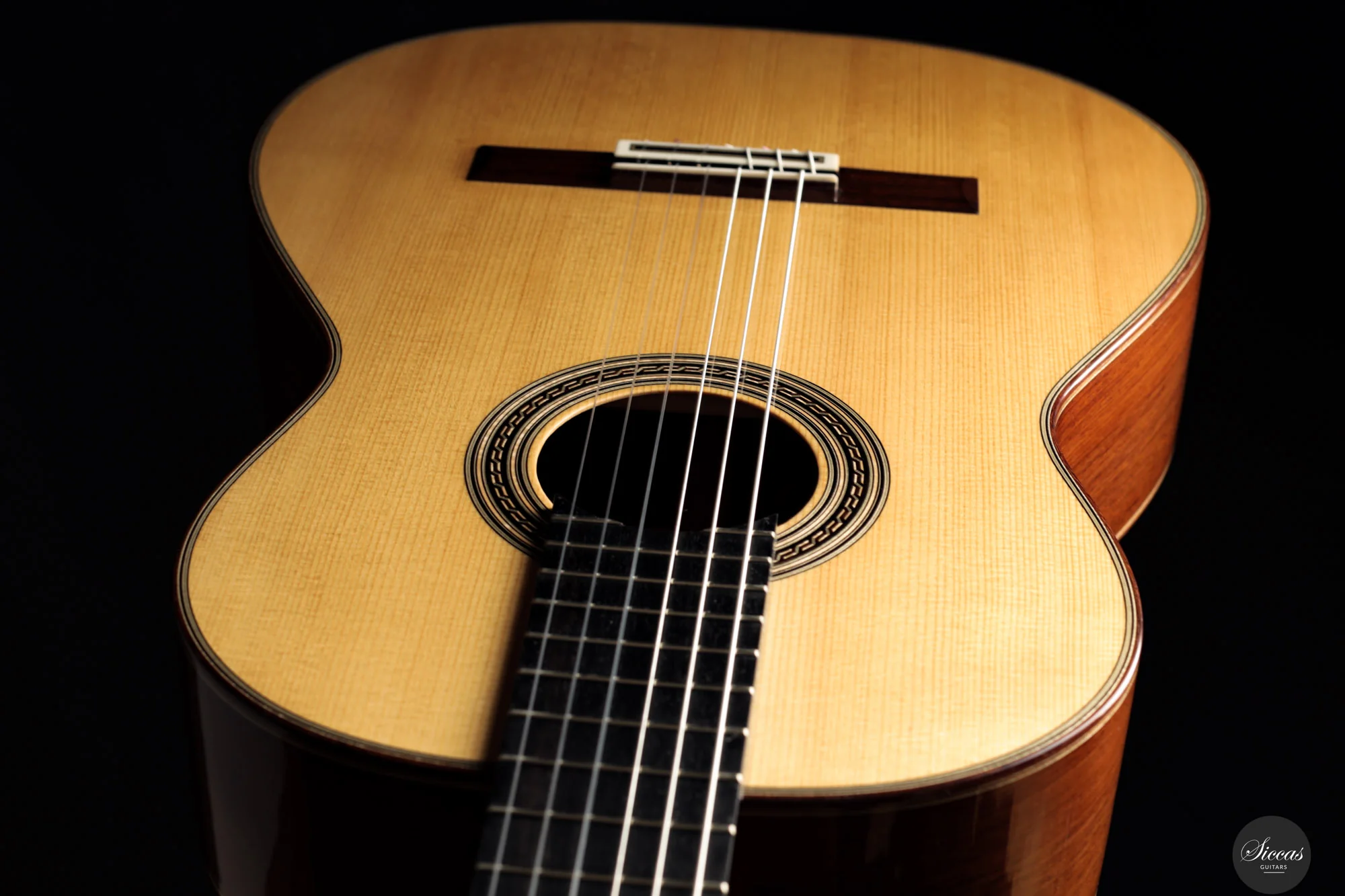
This 2026 guitar by Umberto Cevoli is a Torres inspired model built in a deliberately traditional spirit. The concept is not that of a strict copy, but of an instrument shaped by close study of historical Spanish making and adapted into a personal working method. Cevoli’s approach here centres on a light structure, a relatively compact body, and a very low Eigenresonanz, all of which contribute directly to the guitar’s musical behaviour.
The voice is immediate and highly responsive. Notes emerge with unusual speed and a clear sense of propulsion, giving the instrument a vivid and elastic reaction under the right hand. At the same time, the sound retains a darker colour and a slightly boxy core that places it firmly in a historical aesthetic rather than a modern concert guitar ideal. What makes this especially convincing is that the darker character does not blur the musical line. Individual notes remain easy to follow, and chord textures preserve their internal separation even when the sound becomes fuller and more resonant.
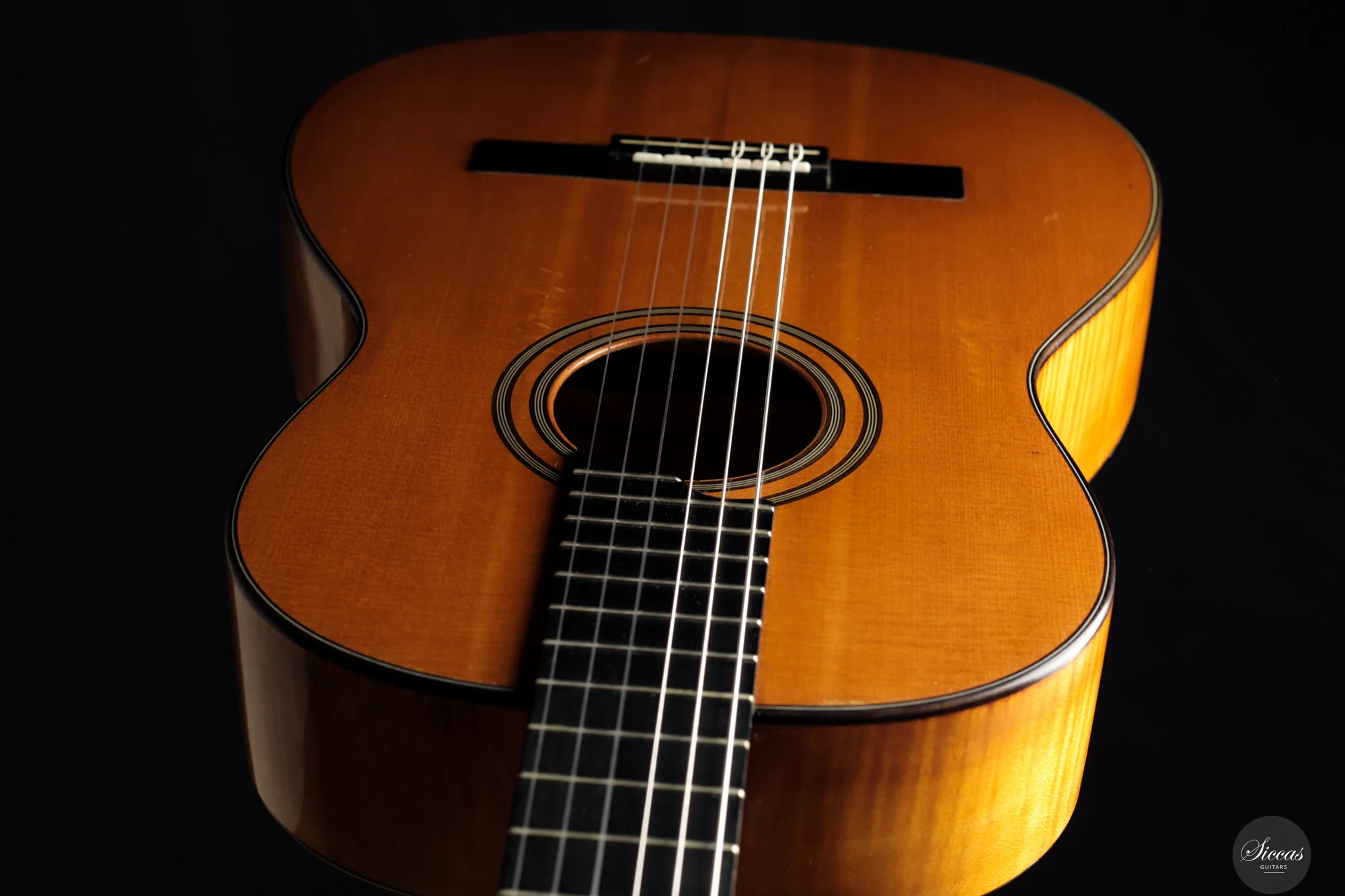
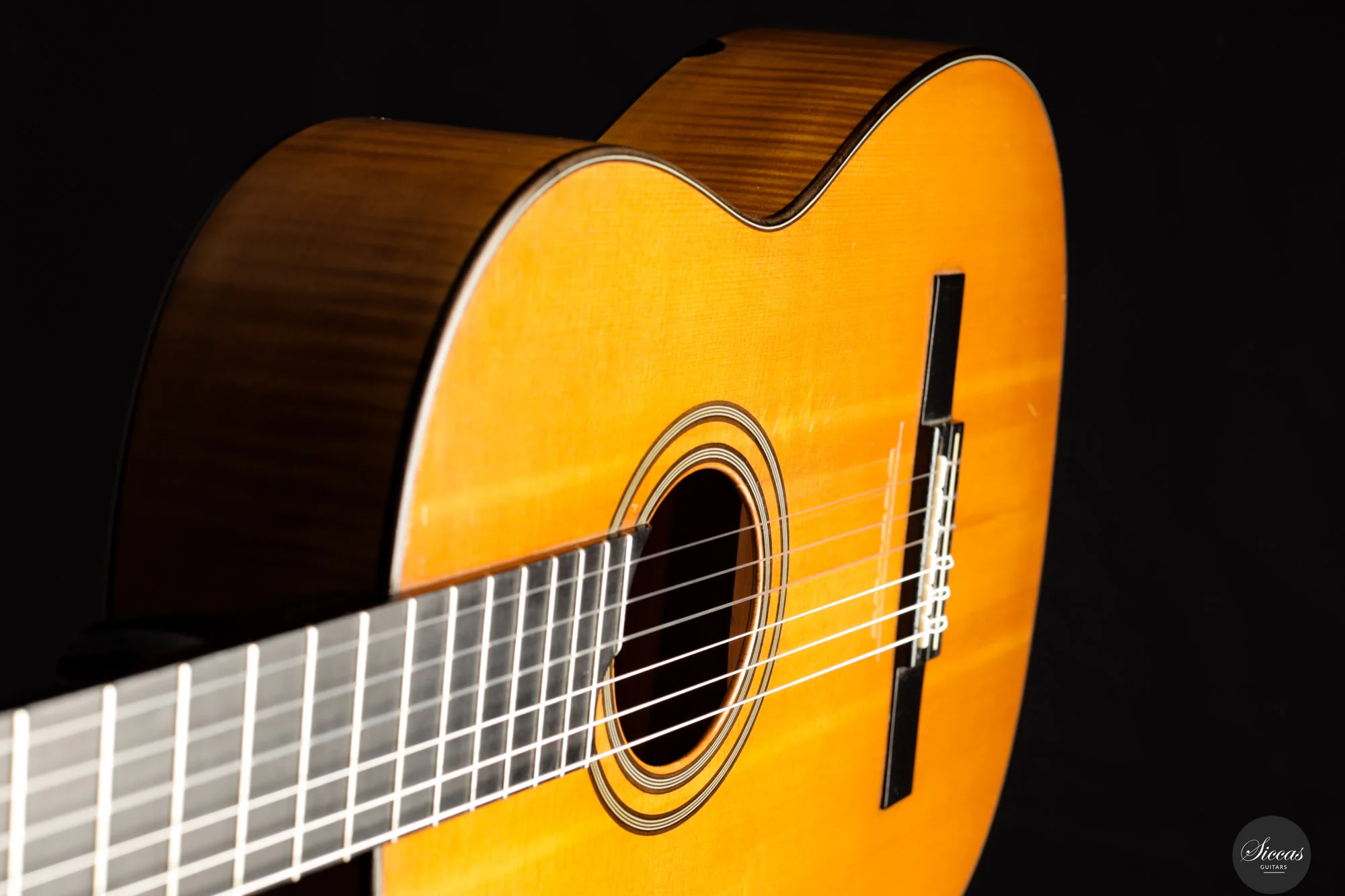
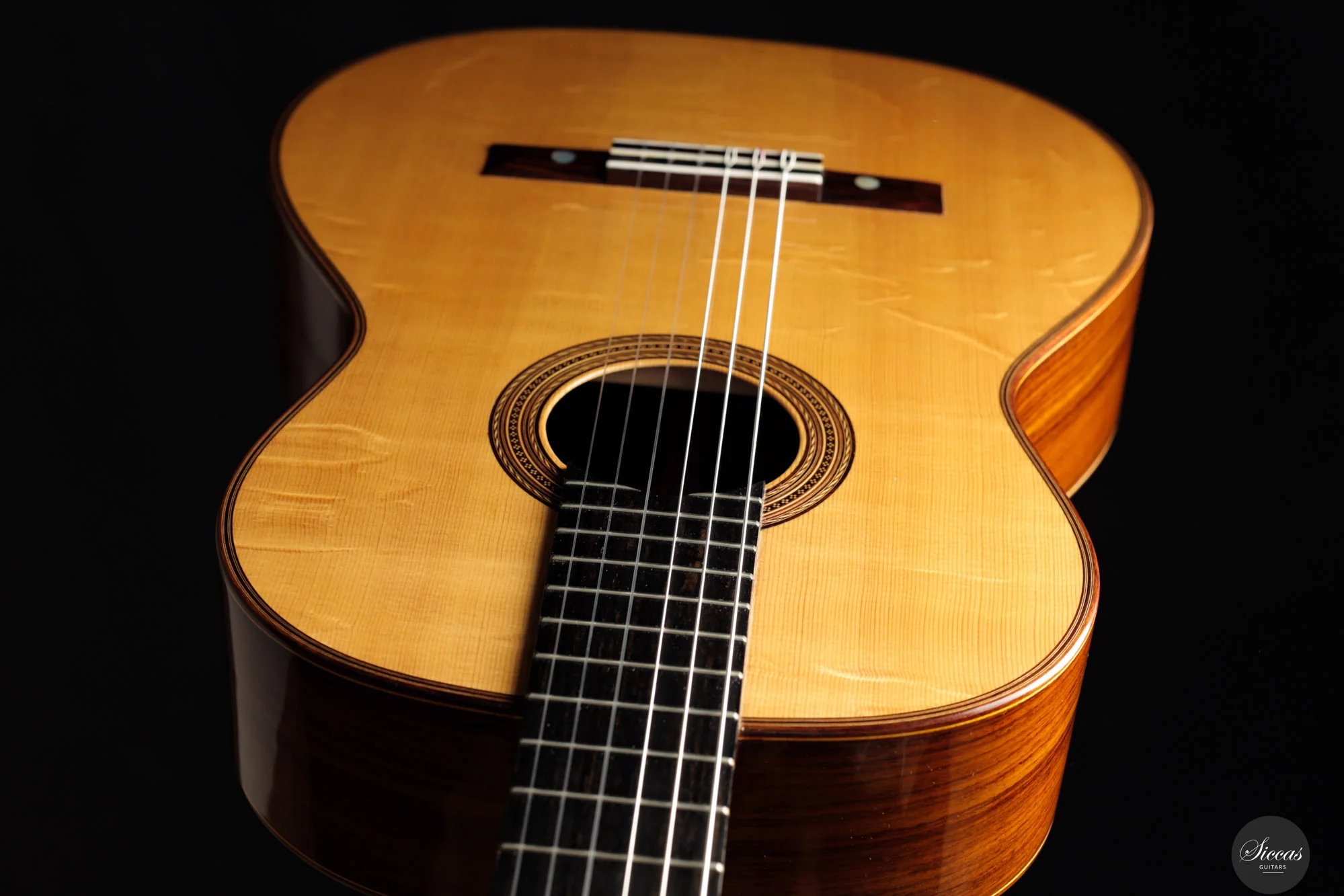
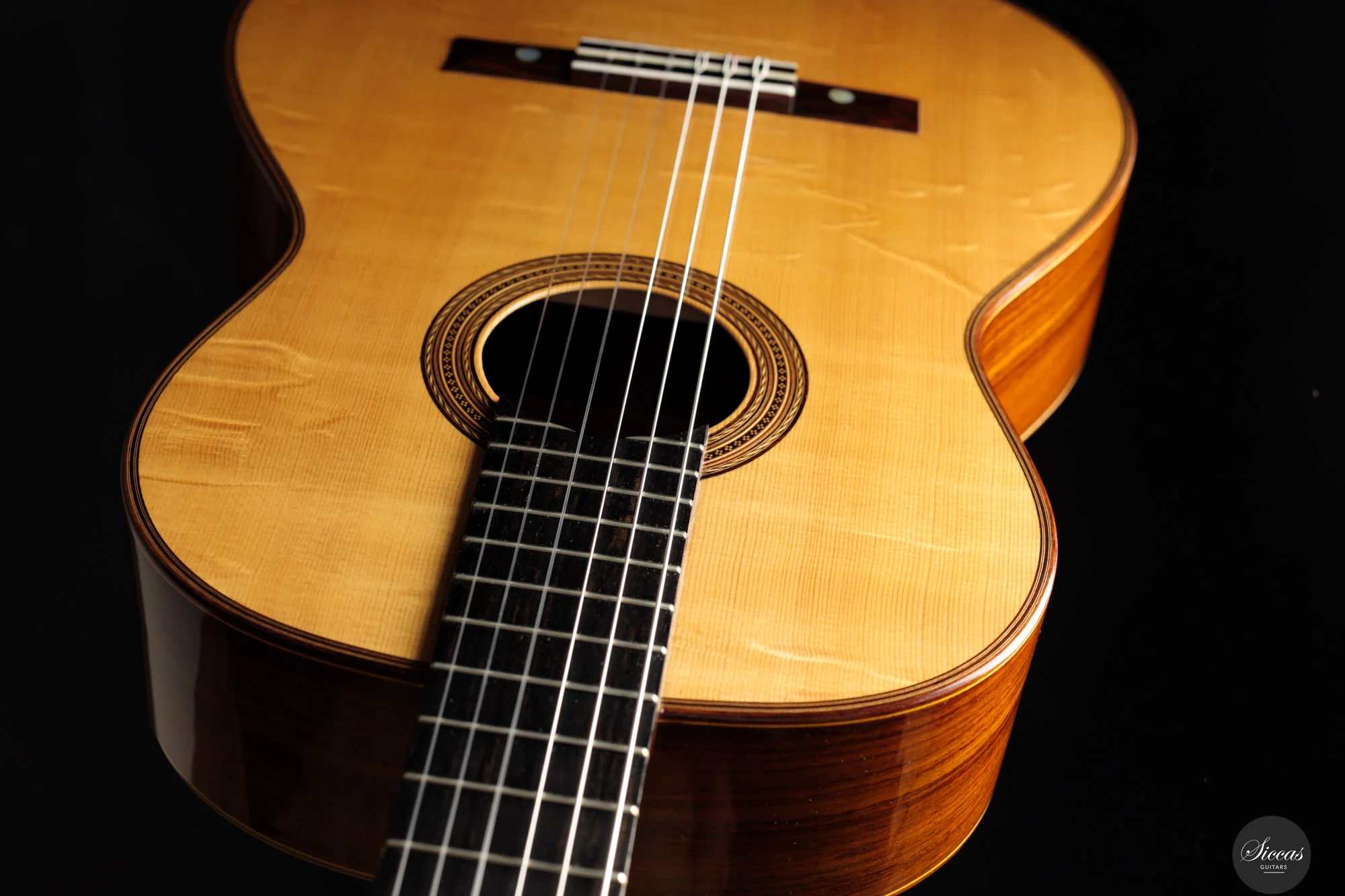
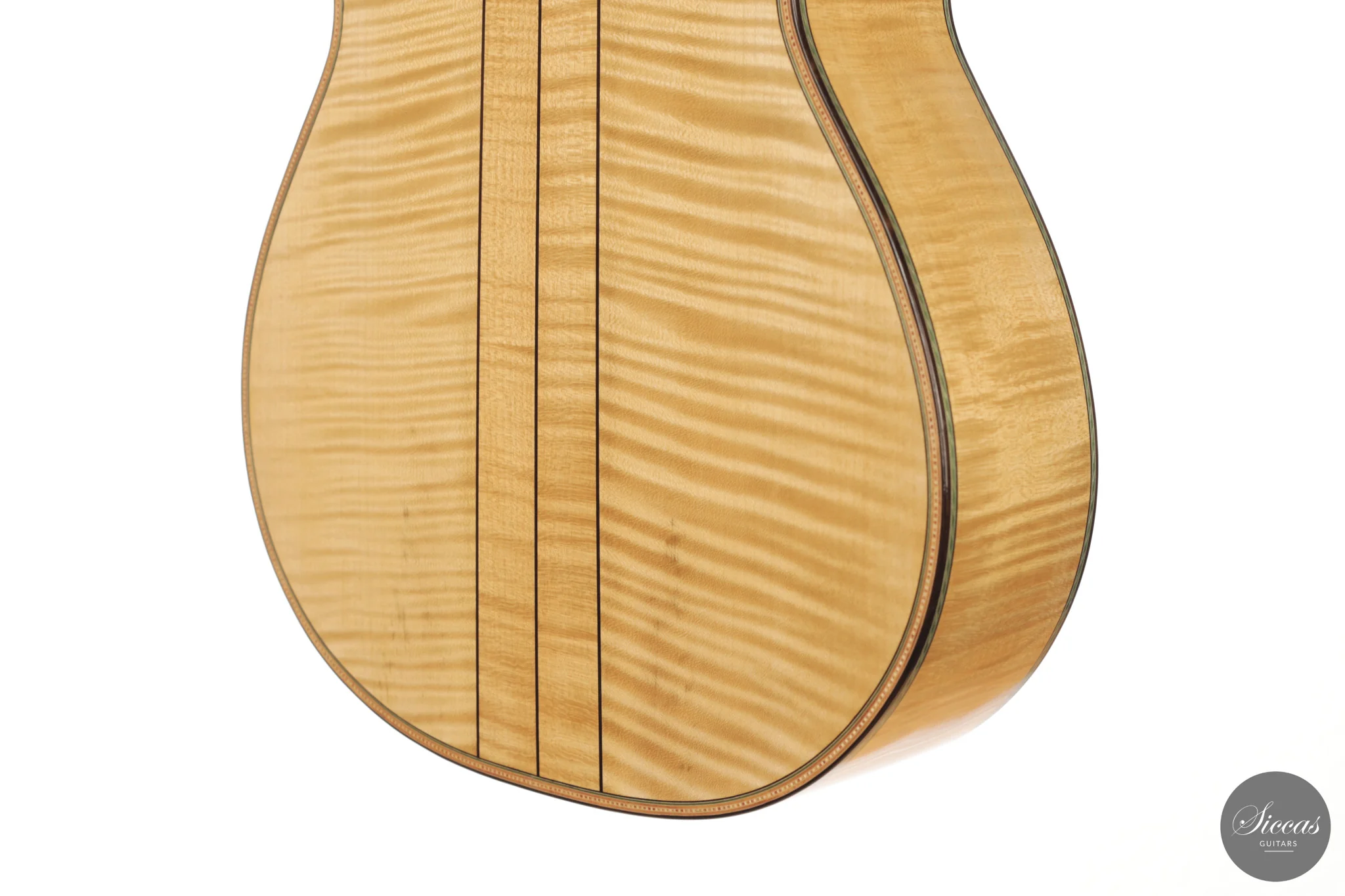
The spruce top and flamed maple body are central to that result. In this instrument the maple does not simply brighten the sound. Instead, it helps stabilise the tonal image, lending clarity, dryness, and a certain natural restraint that suits the low body resonance especially well. The result is a sound that feels organised and controlled, with depth in the basses, a distinct colour palette across the register, and trebles that remain singing without becoming overextended in sustain. The decay is not overly long, but this shorter envelope contributes to the guitar’s agile articulation and to its capacity for colour changes with minimal effort from the player.
Cevoli’s work on this model is therefore best understood through its response and balance rather than through construction details alone. It offers a fast, lively attack, a deep but contained bass foundation, and a tonal character that invites nuance. The guitar feels compact and direct in the hands, yet its projection suggests an instrument with clear concert potential. It is a thoughtful interpretation of a historical idea, shaped with precision and with a strong sense of how traditional materials and proportions can still produce a distinctive and musically rich result today.
Original: $9,213.55
-70%$9,213.55
$2,764.06Product Information
Product Information
Shipping & Returns
Shipping & Returns
Description
About the luthier
Umberto Cevoli was born and raised in Rimini in a family of watchmakers, an environment that shaped his sensitivity to precision, manual discipline, and refined craft from an early age. Alongside his scientific and musical education in Rimini, he studied guitar with Aldo Vianello at the Conservatorio Lettimi and soon developed a lasting interest in the making of instruments. His first guitar, built at the age of eighteen in the workshop of Heidi Pulfer and Pio Sbrighi, marked the beginning of a path that led him toward professional training in lutherie.
He later graduated with highest marks from the Civica Scuola di Liuteria di Milano, where he combined workshop practice with organological study. His final thesis examined proportional systems and units of measurement in the guitars attributed to Antonio Stradivari and explored their possible reconstruction from historical documentation preserved in Cremona. During these years he carried out technical studies on a range of historical instruments and deepened his understanding of historical construction methods. Further experience in the workshop of Enrico Bottelli and continued collaboration with Gabriele Lodi strengthened both his making and restoration practice, especially in relation to historical guitars and the early development of the classical instrument.
Today Cevoli works in Rimini, where his workshop reflects a clear commitment to traditional guitar making informed by direct study of historical models. His work is closely connected to research into proportional design, Spanish traditions of construction, and the material logic of older instruments. Although still early in his career, his formation already shows an unusual breadth, linking practical craftsmanship with sustained historical enquiry.
About the guitar
This 2026 guitar by Umberto Cevoli is a Torres inspired model built in a deliberately traditional spirit. The concept is not that of a strict copy, but of an instrument shaped by close study of historical Spanish making and adapted into a personal working method. Cevoli’s approach here centres on a light structure, a relatively compact body, and a very low Eigenresonanz, all of which contribute directly to the guitar’s musical behaviour.
The voice is immediate and highly responsive. Notes emerge with unusual speed and a clear sense of propulsion, giving the instrument a vivid and elastic reaction under the right hand. At the same time, the sound retains a darker colour and a slightly boxy core that places it firmly in a historical aesthetic rather than a modern concert guitar ideal. What makes this especially convincing is that the darker character does not blur the musical line. Individual notes remain easy to follow, and chord textures preserve their internal separation even when the sound becomes fuller and more resonant.
The spruce top and flamed maple body are central to that result. In this instrument the maple does not simply brighten the sound. Instead, it helps stabilise the tonal image, lending clarity, dryness, and a certain natural restraint that suits the low body resonance especially well. The result is a sound that feels organised and controlled, with depth in the basses, a distinct colour palette across the register, and trebles that remain singing without becoming overextended in sustain. The decay is not overly long, but this shorter envelope contributes to the guitar’s agile articulation and to its capacity for colour changes with minimal effort from the player.
Cevoli’s work on this model is therefore best understood through its response and balance rather than through construction details alone. It offers a fast, lively attack, a deep but contained bass foundation, and a tonal character that invites nuance. The guitar feels compact and direct in the hands, yet its projection suggests an instrument with clear concert potential. It is a thoughtful interpretation of a historical idea, shaped with precision and with a strong sense of how traditional materials and proportions can still produce a distinctive and musically rich result today.