






José Luis Romanillos - 1979 - La Diez Y Ocho No. 571
About the luthier
José Luis Romanillos Vega was born in Madrid in 1932, where he began his cabinet-making apprenticeship at the age of thirteen. In 1956, he moved to England to work at a hospital in Epsom and shortly afterward in London. It was during this period that he built his first Spanish guitar in 1961.
Encouraged by the English guitarist Julian Bream, Romanillos established a guitar-making workshop in the village of Semley, Wiltshire, in 1970. His guitars have since been celebrated by musicians around the world for their sound quality and aesthetic refinement. Romanillos sought clarity, harmonic balance, and what he described as the elusive “Spanish sound”, qualities he consistently achieved through his craftsmanship.
The Daily Mail once referred to him as “the Stradivari of the guitar,” and the Italian magazine Sei Corde called him “the most important living stringed instrument maker.” Beyond building guitars, Romanillos gave lectures and seminars on guitar making and the organology of the instrument, and he conducted courses in various countries. He also researched and lectured on the history and development of the Spanish guitar and the vihuela de mano.
He was a member of the Crafts Council of Great Britain for ten years. From 1995 onward, he lived in Guijosa, a small rural district of Sigüenza in the province of Guadalajara, Spain. Together with his wife Marian, he published the reference work The Vihuela de Mano and the Spanish Guitar in 2002, a comprehensive dictionary of Spanish stringed-instrument and guitar makers.
About the guitar
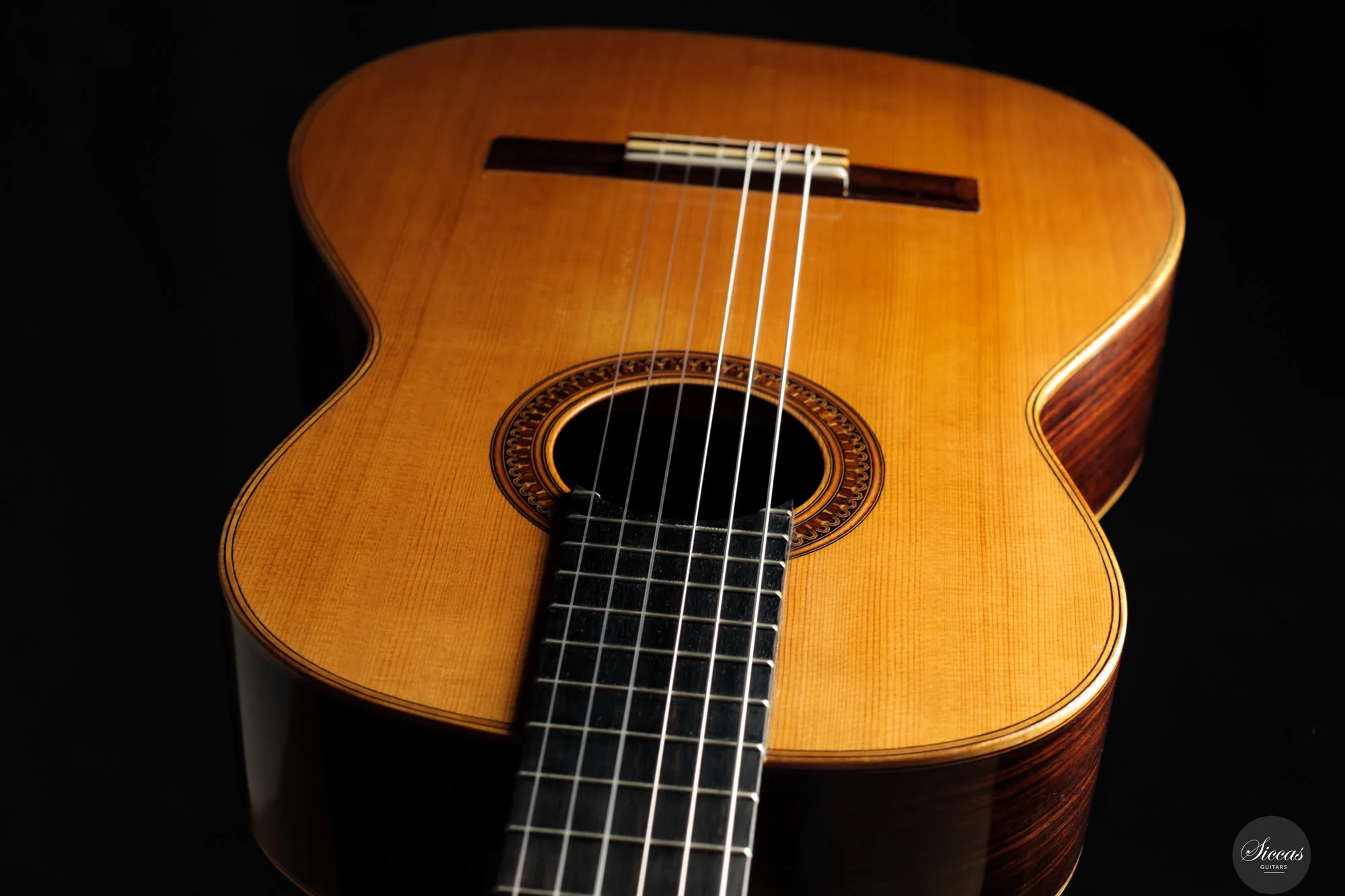
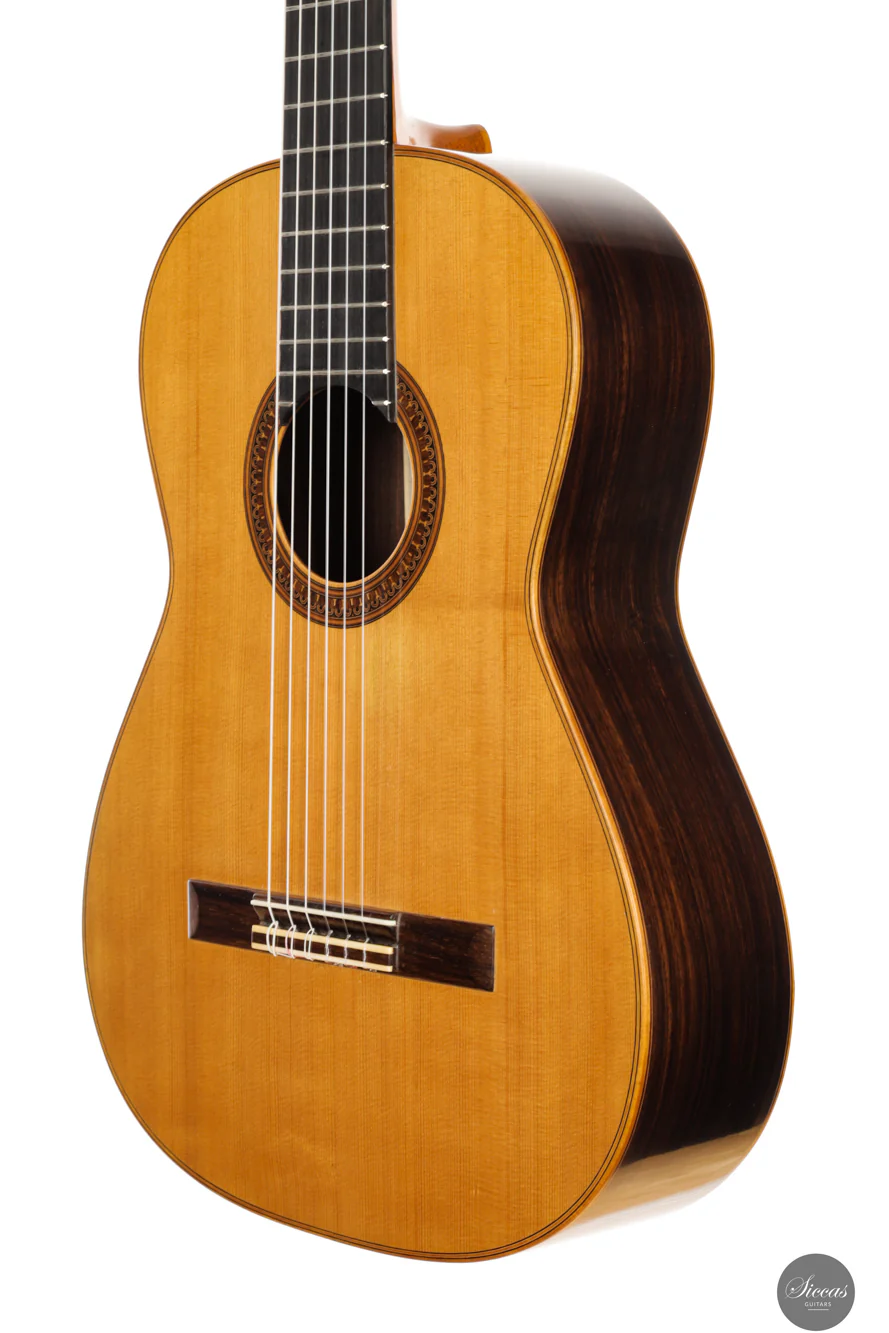
“La Diez y Ocho”, numbered 571, is a landmark instrument in the œuvre of José Luis Romanillos. Built in 1979, its name, meaning “The Eighteen”, was chosen to commemorate the 18th birthday of Romanillos’ son Ignacio. The serial number beginning with 5 indicates that this guitar was constructed using a plantilla based on a 1930 Hermann Hauser I model, which Romanillos held in high esteem for its refined proportions and tonal balance.
This particular guitar holds exceptional provenance, having belonged to the Japanese guitarist Yoshinobu Iwanaga. It was the instrument he played during the 1982 edition of the Segovia Guitar Competition, with Andrés Segovia himself in attendance. Iwanaga’s performance with this guitar is documented in a filmed documentary covering that year’s competition, where several segments show him performing on stage with “La Diez y Ocho.”
One of the most distinctive features of this guitar is its headstock. Unlike the typical Romanillos design with three rounded arches, this head displays a softly pointed “Pope’s hat” profile. In A Collection of Fine Spanish Guitars, Sheldon Urlik recounts that according to correspondence with Romanillos, this shape was not part of a deliberate design plan. Instead, it emerged gradually and intuitively during the carving process. Romanillos found the form pleasing as it took shape and decided to preserve it, allowing the wood and his hand to guide the outcome rather than adhering strictly to his usual template. He noted that only one of his guitars, the 1980 “La Filmá” (No. 575), had this head shape, making it a singular occurrence in his body of work. Yet this 1979 guitar now reveals a second, previously undocumented instance of this rare profile. This subtle but significant departure highlights Romanillos’ sensitivity to form and his willingness to embrace the uniqueness of each instrument as it developed under his tools.
This detail, combined with the guitar’s documented history and exceptional craftsmanship, marks it as one of the most historically and artistically significant Romanillos instruments.
Condition
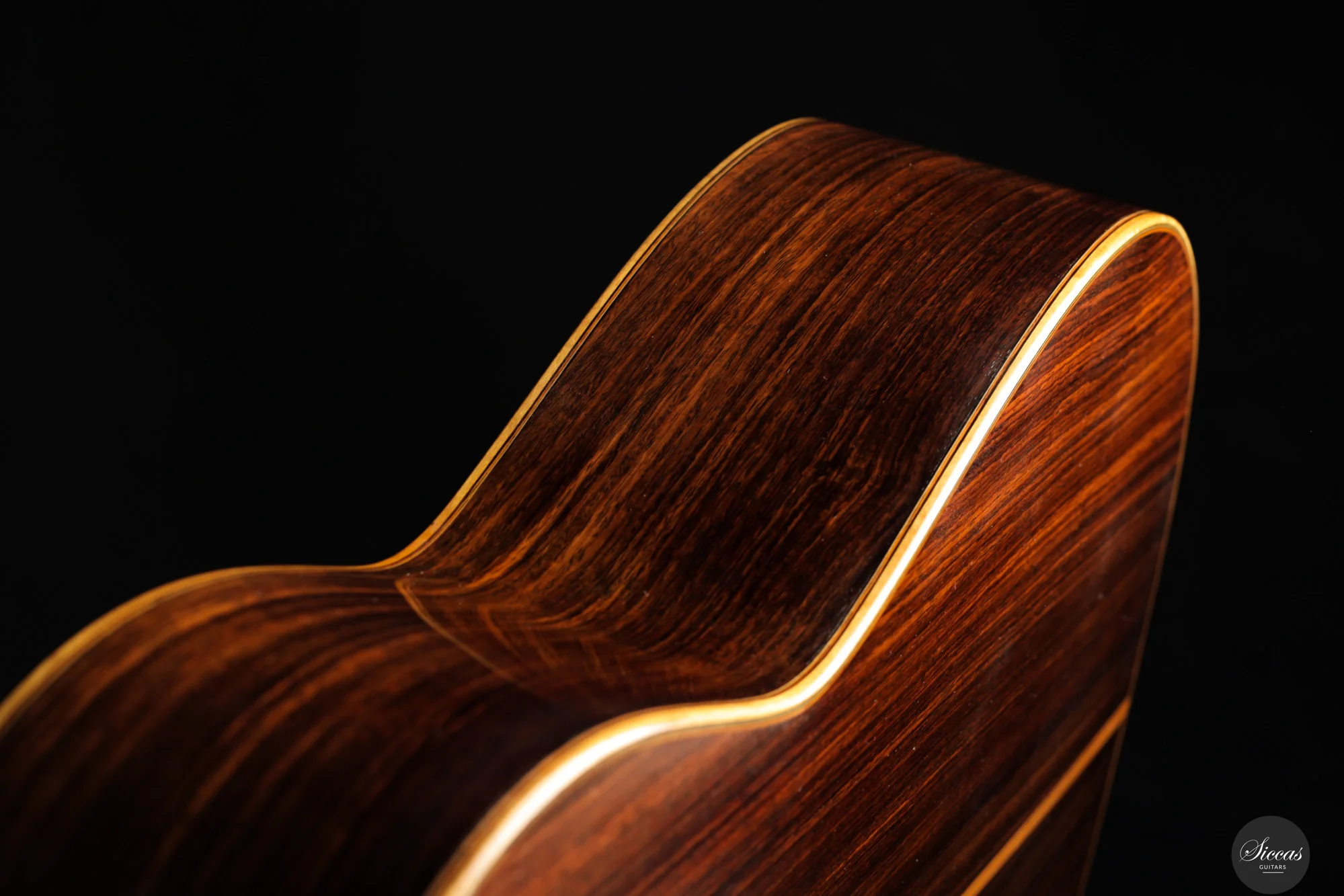
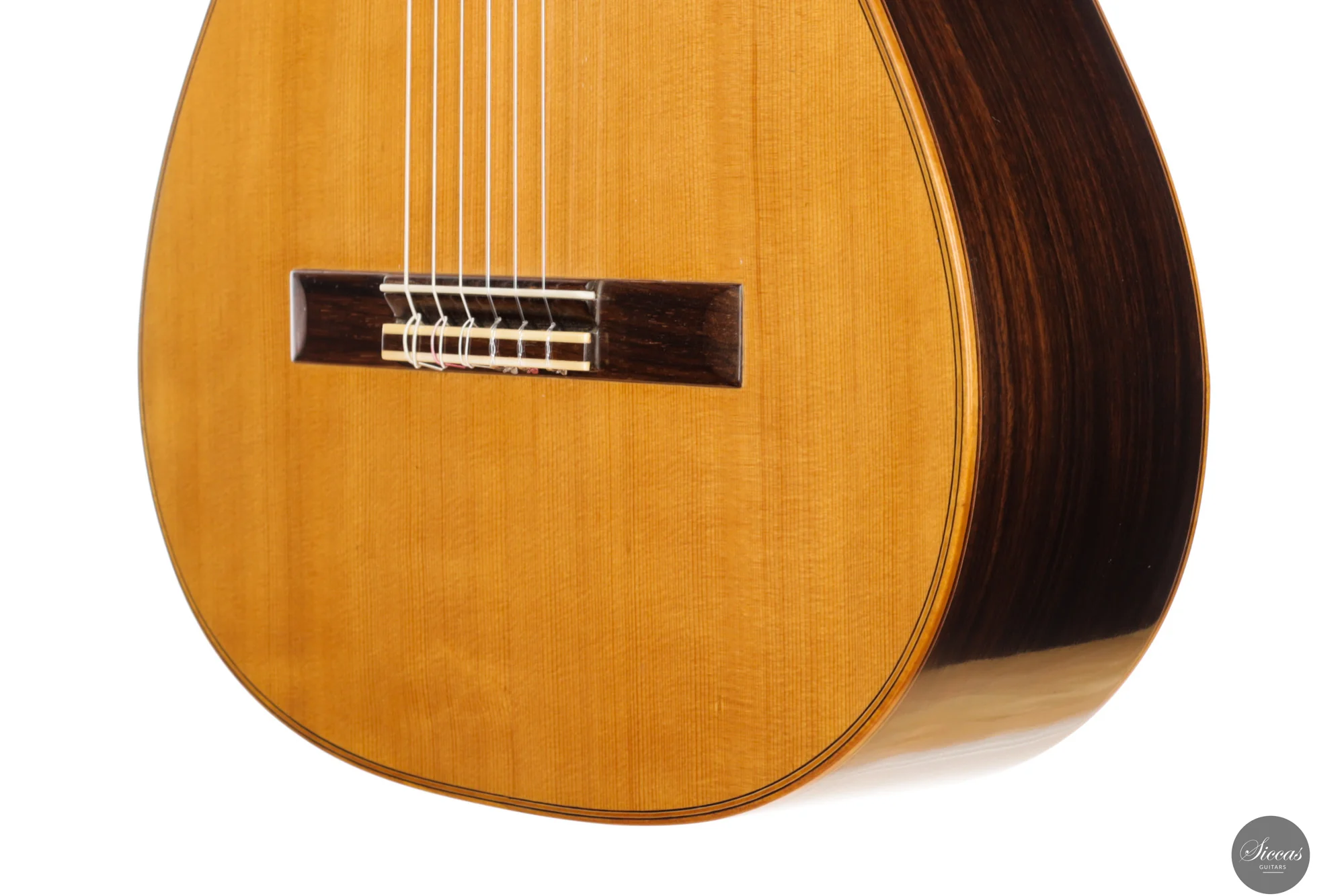
This Romanillos guitar from 1979 is in excellent condition, with only minimal signs of use consistent with its age and professional background. There are two barely visible cracks: a short hairline crack on the top, to the left of the bridge, which has been reinforced with cleats on the inside, and a fine crack on the back that has been professionally repaired without the need for internal reinforcement. The French polish is very well preserved, and the instrument retains its full aesthetic and tonal integrity. The Rodgers tuning machines, crafted to a high visual and mechanical standard, complement the guitar’s elegant appearance and emphasize its collectible value.
Original: $1,153,134,998.85
-70%$1,153,134,998.85
$345,940,499.65Product Information
Product Information
Shipping & Returns
Shipping & Returns
Description
About the luthier
José Luis Romanillos Vega was born in Madrid in 1932, where he began his cabinet-making apprenticeship at the age of thirteen. In 1956, he moved to England to work at a hospital in Epsom and shortly afterward in London. It was during this period that he built his first Spanish guitar in 1961.
Encouraged by the English guitarist Julian Bream, Romanillos established a guitar-making workshop in the village of Semley, Wiltshire, in 1970. His guitars have since been celebrated by musicians around the world for their sound quality and aesthetic refinement. Romanillos sought clarity, harmonic balance, and what he described as the elusive “Spanish sound”, qualities he consistently achieved through his craftsmanship.
The Daily Mail once referred to him as “the Stradivari of the guitar,” and the Italian magazine Sei Corde called him “the most important living stringed instrument maker.” Beyond building guitars, Romanillos gave lectures and seminars on guitar making and the organology of the instrument, and he conducted courses in various countries. He also researched and lectured on the history and development of the Spanish guitar and the vihuela de mano.
He was a member of the Crafts Council of Great Britain for ten years. From 1995 onward, he lived in Guijosa, a small rural district of Sigüenza in the province of Guadalajara, Spain. Together with his wife Marian, he published the reference work The Vihuela de Mano and the Spanish Guitar in 2002, a comprehensive dictionary of Spanish stringed-instrument and guitar makers.
About the guitar
“La Diez y Ocho”, numbered 571, is a landmark instrument in the œuvre of José Luis Romanillos. Built in 1979, its name, meaning “The Eighteen”, was chosen to commemorate the 18th birthday of Romanillos’ son Ignacio. The serial number beginning with 5 indicates that this guitar was constructed using a plantilla based on a 1930 Hermann Hauser I model, which Romanillos held in high esteem for its refined proportions and tonal balance.
This particular guitar holds exceptional provenance, having belonged to the Japanese guitarist Yoshinobu Iwanaga. It was the instrument he played during the 1982 edition of the Segovia Guitar Competition, with Andrés Segovia himself in attendance. Iwanaga’s performance with this guitar is documented in a filmed documentary covering that year’s competition, where several segments show him performing on stage with “La Diez y Ocho.”
One of the most distinctive features of this guitar is its headstock. Unlike the typical Romanillos design with three rounded arches, this head displays a softly pointed “Pope’s hat” profile. In A Collection of Fine Spanish Guitars, Sheldon Urlik recounts that according to correspondence with Romanillos, this shape was not part of a deliberate design plan. Instead, it emerged gradually and intuitively during the carving process. Romanillos found the form pleasing as it took shape and decided to preserve it, allowing the wood and his hand to guide the outcome rather than adhering strictly to his usual template. He noted that only one of his guitars, the 1980 “La Filmá” (No. 575), had this head shape, making it a singular occurrence in his body of work. Yet this 1979 guitar now reveals a second, previously undocumented instance of this rare profile. This subtle but significant departure highlights Romanillos’ sensitivity to form and his willingness to embrace the uniqueness of each instrument as it developed under his tools.
This detail, combined with the guitar’s documented history and exceptional craftsmanship, marks it as one of the most historically and artistically significant Romanillos instruments.
Condition
This Romanillos guitar from 1979 is in excellent condition, with only minimal signs of use consistent with its age and professional background. There are two barely visible cracks: a short hairline crack on the top, to the left of the bridge, which has been reinforced with cleats on the inside, and a fine crack on the back that has been professionally repaired without the need for internal reinforcement. The French polish is very well preserved, and the instrument retains its full aesthetic and tonal integrity. The Rodgers tuning machines, crafted to a high visual and mechanical standard, complement the guitar’s elegant appearance and emphasize its collectible value.

